The Process by Which Water Moves Through the Environment Over and Over Again Is Called
THE WATER Bike: A GUIDE FOR STUDENTS

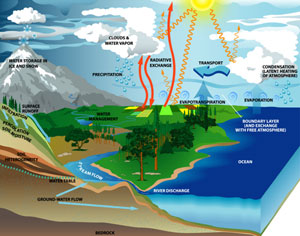
Water Wheel
(Mouse over to see larger picture)
Water is the bones chemical element of nature. It covers 70% of the earth's surface. It provides life, eases out heat, drains harmful substances and mediates many day-to-day works. Water needs to be replenished, purified and circulated again and again and so that it tin perform its functions. Nature does this job through a process called the water bicycle. Also known as hydrologic cycle, the water cycle is a phenomenon where h2o moves through the 3 phases (gas, liquid and solid) over the four spheres (atmosphere, lithosphere, hydrosphere and biosphere) and completes a total cycle. The water bike has many effects: it regulates the temperature of the surroundings. Information technology changes weather condition and creates pelting. It helps in conversion of rocks to soil. It circulates important minerals through the spheres. It also creates the many geographical features present on earth like the ice caps of mountains, icebergs, the rivers and the valleys, lakes, and more. Hence information technology is quite important to empathize and learn the processes of the water cycle. The total cycle forms an endless loop, merely allow's commencement the whole process at the ocean. Since that is where about 96% of full h2o exists on Earth.
Step 1: Evaporation
The water cycle begins with evaporation. Information technology is a process where water at the surface turns into water vapors. H2o absorbs estrus energy from the lord's day and turns into vapors. Water bodies like the oceans, the seas, the lakes and the river bodies are the chief source of evaporation. Through evaporation, h2o moves from hydrosphere to atmosphere. Equally water evaporates it reduces the temperature of the bodies.
Step 2: Condensation
As water vaporizes into h2o vapor, it rises upwards in the atmosphere. At high altitudes the h2o vapors changes into very tiny particles of ice /water droplets because of depression temperature. This process is called condensation. These particles come close together and form clouds and fogs in the sky.
Pace 3: Sublimation
Apart from evaporation, sublimation also contributes to water vapors in the air. Sublimation is a process where ice direct converts into h2o vapors without converting into liquid h2o. This phenomenon accelerates when the temperature is low or pressure level is high. The primary sources of h2o from sublimation are the ice sheets of the North Pole and the South Pole and the water ice caps on the mountains. Sublimation is a rather slower procedure than evaporation.
Step iv: Atmospheric precipitation
The clouds (condensed water vapors) then pour down as precipitation due to wind or temperature change. This occurs because the water droplets combine to brand bigger droplets. Also when the air cannot hold whatever more water, it precipitates. At high altitudes the temperature is low and hence the droplets lose their heat free energy. These h2o aerosol fall down as rain. If the temperature is very low (beneath 0 degrees), then the water droplets would autumn as snowfall. In addition, water could also precipices in the form of drizzle, sleet and hail. Hence water enters lithosphere.
Footstep 5: Transpiration
Equally water precipitates, some of it is absorbed by the soil. This water enters into the procedure of transpiration. Transpiration is a process similar to evaporation where liquid water is turned into water vapor by the plants. The roots of the plants absorb the water and push it toward leaves where it is used for photosynthesis. The extra water is moved out of leaves through stomata (very tiny openings on leaves) equally h2o vapor. Thus water enters the biosphere and exits into gaseous stage.
Footstep 6: Runoff
As the water pours downward (in any form), it leads to runoff. Runoff is the process where water runs over the surface of earth. When the snow melts into water it too leads to runoff. As water runs over the ground it displaces the meridian soil with it and moves the minerals forth with the stream. This runoff combines to form channels, rivers and ends up into lakes, seas and oceans. Here the water enters hydrosphere.
Pace 7: Infiltration
Some of the water that precipitates does non runoff into the rivers and is absorbed past the plants or gets evaporated. It moves deep into the soil. This is called infiltration. The h2o seeps down and increases the level of footing water table. It is called pure water and is drinkable. The infiltration is measured as inches of h2o-soaked by the soil per hour.
Expect beneath for more information in understanding the phenomenon of the water cycle.
For Students:
For Teachers:
herrerawhippyraton.blogspot.com
Source: https://www.freedrinkingwater.com/resource-water-cycle-student-guide.htm
0 Response to "The Process by Which Water Moves Through the Environment Over and Over Again Is Called"
Post a Comment